

Harmonycrumb, 2023
Spike Island, Bristol
Harmonycrumb was a commission for Spike Island, Bristol, exploring trans and gender non-conforming histories through painting and assemblage.
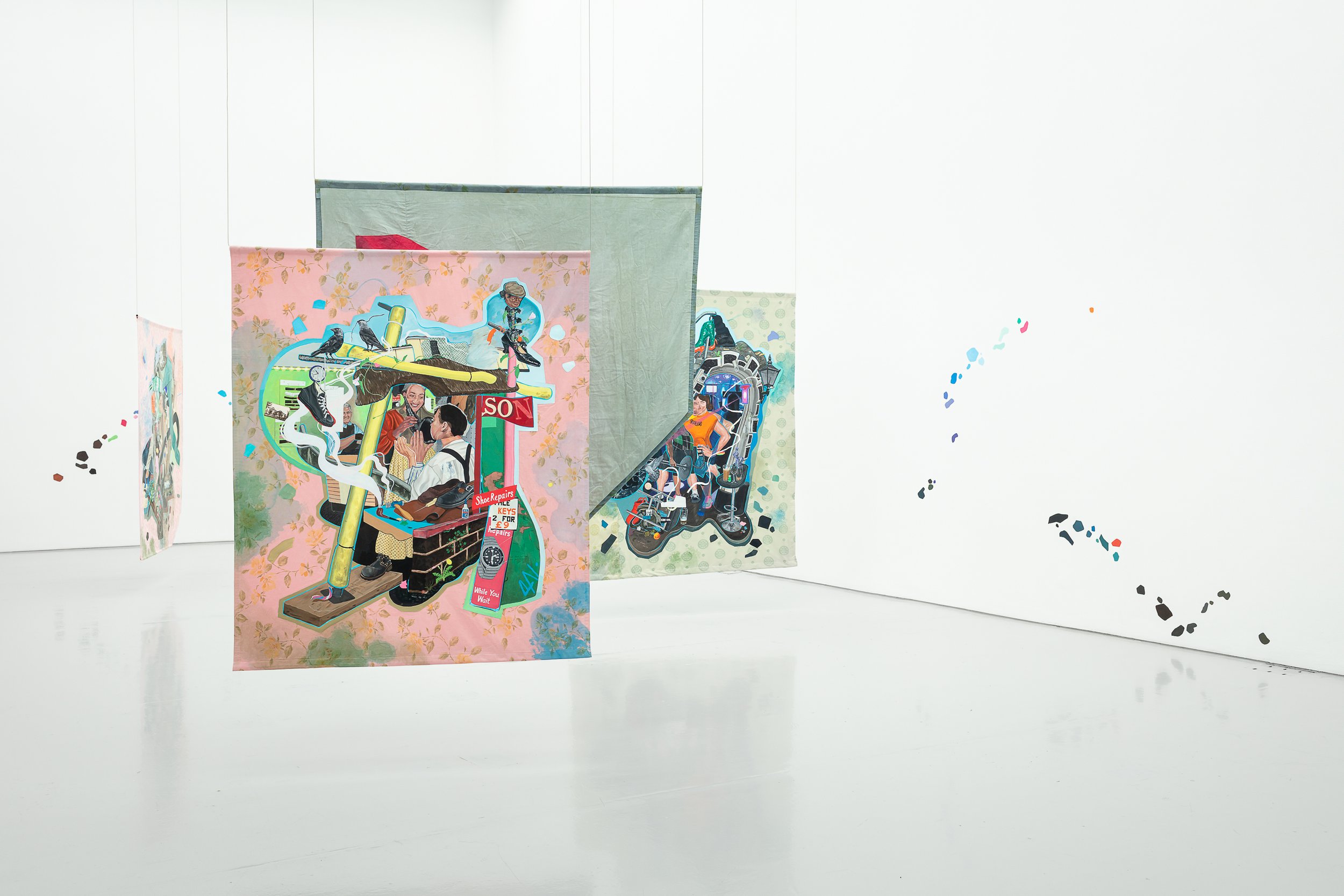
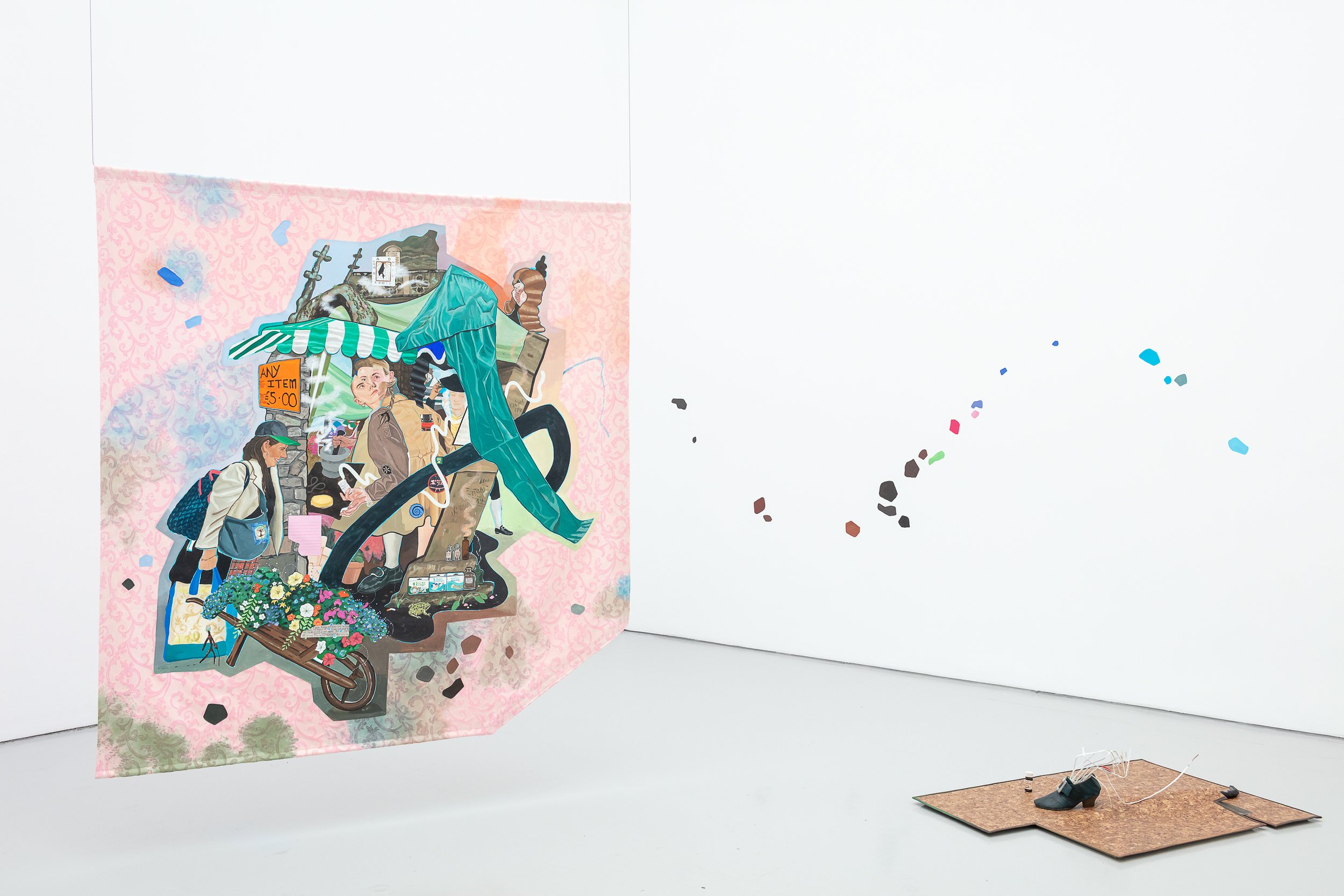
The exhibition included acrylic paintings appliqued onto found fabric, and assemblages composed of lino flooring cutouts and handmade objects. Together, these works explored speculative entanglements between Brooks' own life and the experiences of different historical figures, including military leader Joan of Arc (1412-31), 'female husband' Charles Hamilton (1721-46), and physician Michael Dillon/Lobzang Jivaka (1915-62).
Embedded in the materials of domestic space, which Brooks described as 'the first space of dreaming, fantasising, worlding,' each work originated from fragments of these people's lives, gleaned from newspaper clippings, autobiographical descriptions and visits to the places they lived and worked.
In one painting, Michael Dillon/Lobzang Jivaka was depicted riding a motorbike through the countryside. He was surrounded by images and ephemera that related to the former College Motors garage in Bristol, where he wrote a ground-breaking book about transexualism, Self: A Study in Ethics and Endocrinology, in 1946. In another, Charles Hamilton, who worked as a quack in Somerset, was shown at a market cross, assembling and selling bottles of 18th-century medicines with mysterious-sounding names, such as 'Sovereign Elixir' and 'Viper Drops'. Motifs from Brooks' own life also appeared throughout, forming layered and interweaving narratives that spanned time and space.
Extending out from the paintings, the floor assemblages supported a range of objects and ephemera that were either appropriate to, or out of step with, the period. Some of these objects were placed on and around the lino, which undulated across the floor. Others, such as a broken candlestick and one of Joan of Arc's sabatons (plate armour shoes), emerged from cut out 'windows'.
Collaging together different places, eras and individuals, Brooks' works resisted simplified representations of trans and gender non-conforming lives. Rather they opened up a flexible space for the unfolding of multiple perspectives, shifting identities and evolving relationships. They were not historical portraits but dream-like scenarios: fragmented, mutable, incomplete.
Photos by Dan Weill